
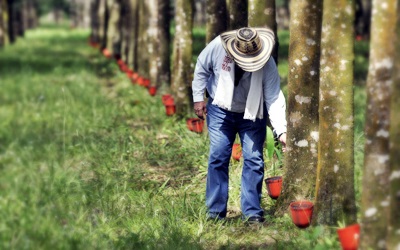
Rubber subsidy likely to backfire
Business Intervention in the price of natural rubber could force domestic tyre producers to use more synthetic rubber.
Chaiyasit Samrittivanicha, the managing director of ND Rubber Co, said both types of rubber can be used to produce tyres depending on the requirements of specific producers.
The prices of both types were close until about three years ago, when demand from China and India drove up the price of natural rubber.
But the economic crisis in the US and Europe has brought down the price of natural rubber, narrowing the price gap, Mr Chaiyasit said.
Natural rubber is priced at about 80 baht a kilogramme compared with 60 baht for synthetic rubber.
“It doesn’t affect us whether the price of raw rubber is high or low as long as it stays close to the market. If the price fluctuates from that, it will be hard for us to compete with other players,” Mr Chaiyasit said.
Each year, ND Rubber consumes about 2,000 tonnes of natural rubber and 1,000 tonnes of synthetic rubber.
Mr Chaiyasit said the rubber market is readjusting to the real price of natural rubber, so planters should learn to adapt as the business sector does.
“The tyre industry will be weakened further if the government levies an additional tax on the downstream rubber industry as planned,” he said.
Mr Chaiyasit also urged the government to help rubber farmers reduce operating costs instead of offering a price guarantee.
Founded in 1992, ND Rubber has served the domestic motorcycle tyre market under its own brand. It also produces tyres for Malaysian firms FKR, Modenas and Y-Teq under original-equipment manufacturing (OEM) contracts.
After earning 700 million baht in revenue last year, the company targets 800 million this year.
It expects revenue to reach 1 billion baht within two years.
Companies in the timber and furniture sector using wood from rubber trees face a different problem.
“The ongoing problem for rubber farmers is only about the price of natural rubber, not the trees themselves,” said Kittiphong Dajkuhapoompitak, the managing director of Parawood Design Industries Co.
The company is competing with cheap imports from China and Vietnam while also having to overcome negative perceptions of parawood furniture.
“Many in Thailand think it is not a quality wood, as termites like it. We don’t have this kind of problem in Europe,” said Mr Kittiphong.
Parawood Design began by doing OEM for machinery and parts for larger furniture manufacturers.
In 2009, it launched its in-house brand Artemis Furniture for custom-made and made-to-order furniture to substitute for decreasing OEM sales.
Earlier, all products were exported to Europe, Japan and South Korea, but now 40% of sales are in Thailand.
Parawood Design achieved revenue of 30 million baht last year but expects a drop of at least 40% this year due to the European crisis, weak domestic consumption and the daily minimum wage hike to 300 baht.
“Our solutions are to reduce our scale of operation, design our own machinery and use specialised workers to answer customers’ needs,” Mr Kittiphong said.